Central Project 2: Data Management, Integration and Analysis

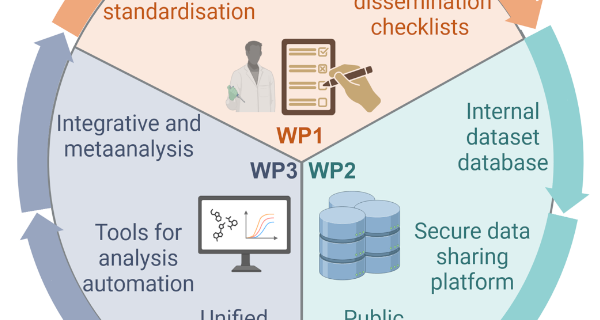
Central project 2 will provide data management expertise to all members of the consortium, unify data collection and analysis pipelines, and ensure sustainable use of all research data acquired during the project. It will provide support to unify data and metadata collection protocols, as well as data management plans across the projects to streamline sharing …

Central Project 1: Functional Microbiomics and Metabolomics Research

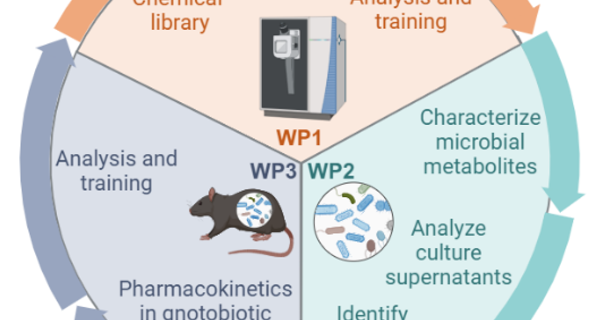
The central project 1 will support the GenoMiCC research unit by providing central metabolomics services, chemical libraries, and support with microbiome-specific animal models. By improving standardisation, developing more sensitive and quantitative analytical methods, and fostering larger collaborative studies, this central project aims to enhance the reproducibility and clinical relevance of microbiome and metabolomics findings in …

Project 8: Schürrle/Schubert – Bacterial engineering, functional genomics

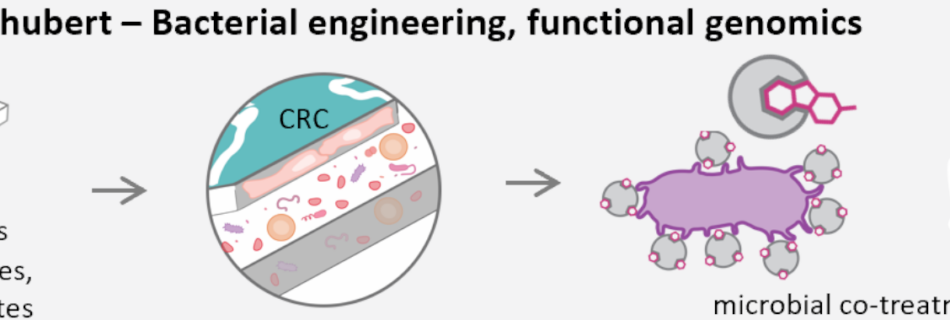
S. Schürle and A. Schubert will use genome engineering with the aim to provide mechanistic insights into signalling pathways in the tumour–microbe–drug interplay. For this, they will utilise and optimise existing organ-on-a-chip models of CRC that mimic physiologically relevant biochemical and physical cues of tumour and metastatic niches. The system provides means to perform multiparametric …

Project 7: Schott/Betge – Translational control, microbiome, therapy resistance

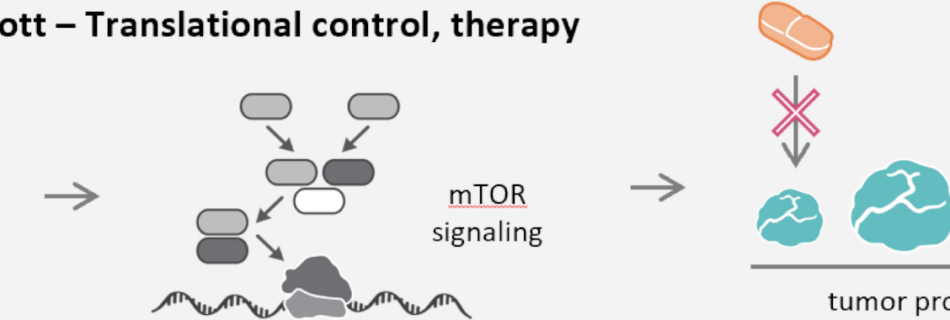
J. Betge and J. Schott hypothesise that specific microbial metabolites affect translation control and thereby plasticity and drug resistance in CRC, mediated by mTOR-dependent and -independent mechanisms. In P7 J. Betge and J. Schott will analyse the activity and heterogeneity of central regulators of translation in PDOs and mouse tumours upon treatment with standard-of-care drugs …

Project 6: Zaugg/Jackstadt – Microbes and cellular plasticity

J. Zaugg, formerly EMBL, now Basel University, and R. Jackstadt propose that complex transcriptional, epigenetic, and microbial changes are interconnected and foster enhanced phenotypic plasticity of metastatic and therapy resistant CRC.They aim to dissect underlying mechanisms that interconnect the microbiome and its metabolome with cell state dynamics and cellular plasticity to define actionable targets. To …

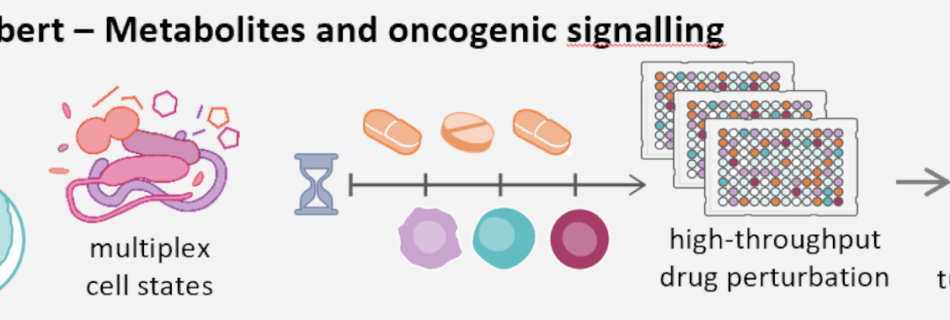
Project 5: Boutros/Ebert – Microbial metabolites and oncogenic signaling

M. Boutros and M. Ebert are interested in the impact of microbial-derived metabolites on tumor progression and treatment response with a focus on Wnt and MAPK signaling. They will utilize a large biobank of patient-derived organoids and perform genetic, transcriptomic and phenotypic profiling to facilitate insights in metabolite- oncogenic signaling-therapy response axis n CRC progression …

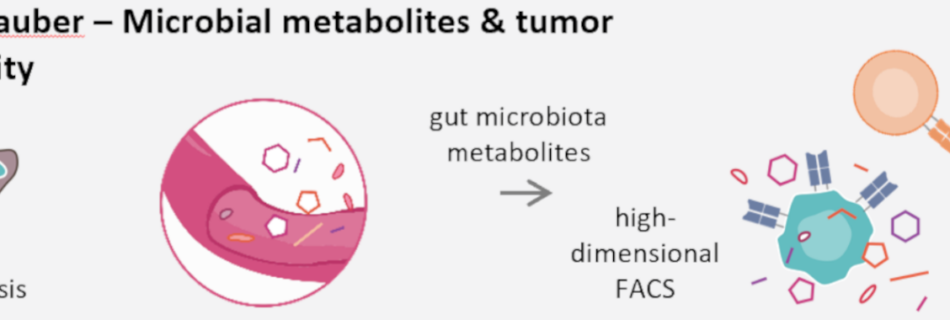
Project 4: Roberti/Rauber – Microbial metabolites & tumor immunogenicity

M.P. Roberti and C. Rauber aim to investigate the influence of gut microbiota-derived metabolites on CRC metastasis with a special focus on their modulation of tumour intrinsic pathways of immune recognition. Previously, M.P. Roberti and C. Rauber have demonstrated in preclinical models that response of microsatellite stable (MSS) CRC to immune checkpoint inhibitors (in combination …

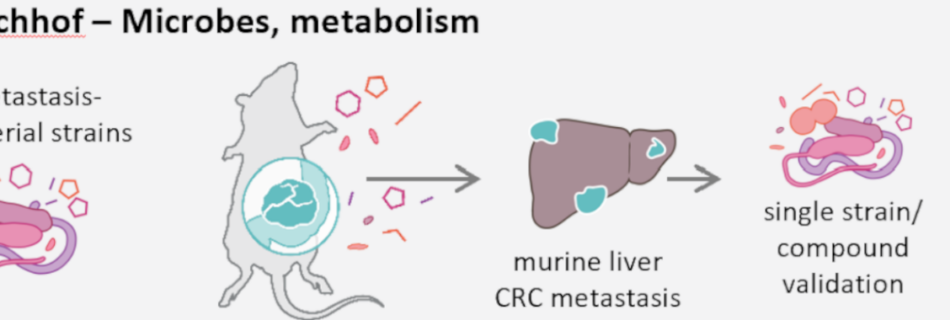
Project 3: Hinze/Puschhof – Microbes, metabolism

The functional implications of the intra-metastasis microbiome are also largely unknown. For this reason, L. Hinze and J. Puschhof hypothesise that the interplay of microbiota-derived factors and metabolic changes influences niche dependency, metastasis phenotypes and thereby therapy response in CRC metastases. Previously, they identified ribosomal proteins of the large and small subunits as drivers of …

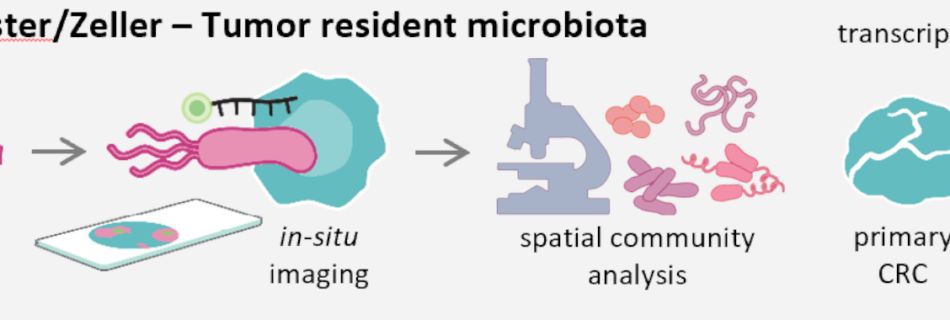
Project 2: Burgermeister/Zeller – Tumor resident microbiota

E. Burgermeister and G. Zeller will build on these spatial studies to reconstitute the key associations discovered in situ using PDO models from primary CRC tumours and metastases. This shall enable mechanistic dissection of microbe-host crosstalk and its impact on the efficacies of chemo- and targeted therapies, paving the way for future microbiome-aware personalised oncology approaches to …

Project 1: Zhan/Zimmermann-Kogadeeva – Microbiota drug metabolism

T. Zhan and M. Zimmermann-Kogadeeva propose to combine their complementary expertise in microbiome research and translational oncology to identify and characterise novel links between gut microbiome drug metabolism and response to cancer therapy in CRC. They propose to assess the gut microbiome contribution to the metabolism of fluoropyrimidines and multi-kinase inhibitors by integrating results from …