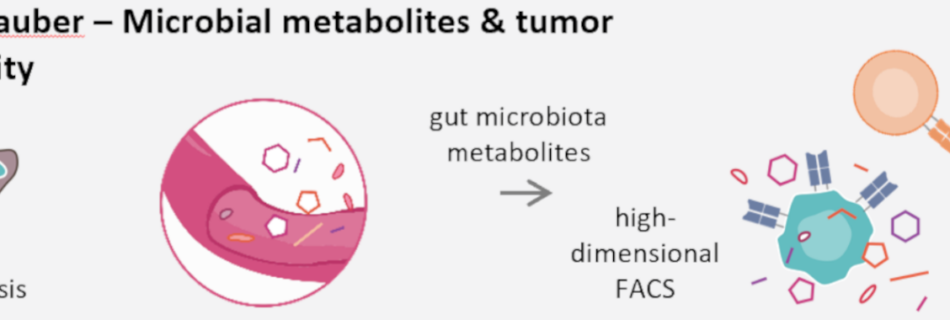
Project 4: Roberti/Rauber – Microbial metabolites & tumor immunogenicity

M.P. Roberti and C. Rauber aim to investigate the influence of gut microbiota-derived metabolites on CRC metastasis with a special focus on their modulation of tumour intrinsic pathways of immune recognition. Previously, M.P. Roberti and C. Rauber have demonstrated in preclinical models that response of microsatellite stable (MSS) CRC to immune checkpoint inhibitors (in combination …

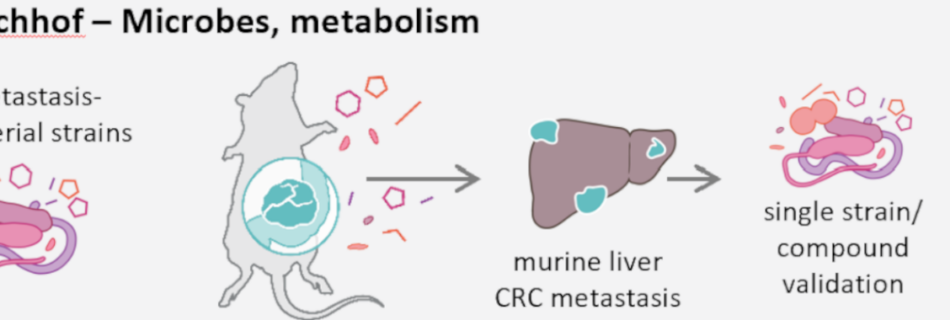
Project 3: Hinze/Puschhof – Microbes, metabolism

The functional implications of the intra-metastasis microbiome are also largely unknown. For this reason, L. Hinze and J. Puschhof hypothesise that the interplay of microbiota-derived factors and metabolic changes influences niche dependency, metastasis phenotypes and thereby therapy response in CRC metastases. Previously, they identified ribosomal proteins of the large and small subunits as drivers of …

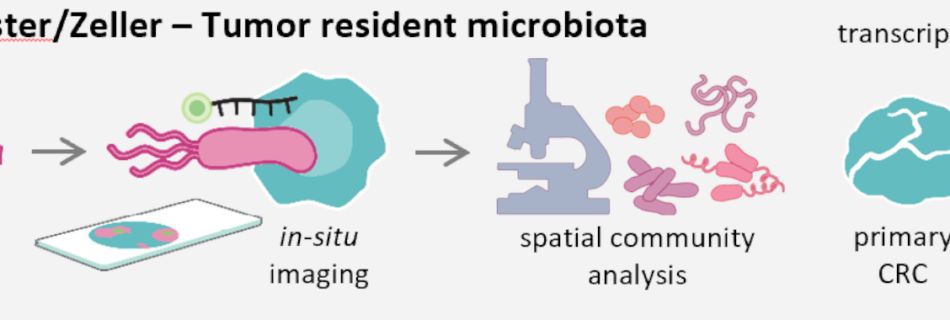
Project 2: Burgermeister/Zeller – Tumor resident microbiota

E. Burgermeister and G. Zeller will build on these spatial studies to reconstitute the key associations discovered in situ using PDO models from primary CRC tumours and metastases. This shall enable mechanistic dissection of microbe-host crosstalk and its impact on the efficacies of chemo- and targeted therapies, paving the way for future microbiome-aware personalised oncology approaches to …

Project 1: Zhan/Zimmermann-Kogadeeva – Microbiota drug metabolism

T. Zhan and M. Zimmermann-Kogadeeva propose to combine their complementary expertise in microbiome research and translational oncology to identify and characterise novel links between gut microbiome drug metabolism and response to cancer therapy in CRC. They propose to assess the gut microbiome contribution to the metabolism of fluoropyrimidines and multi-kinase inhibitors by integrating results from …

Dr. Anne Dropmann

Dr. Anne Dropmann is a postdoctoral researcher specializing in molecular hepatology, with a dedicated focus on the pathogenesis and treatment of cholestatic and biliary liver diseases, including primary sclerosing cholangitis (PSC), primary biliary cholangitis (PBC), and cholangiocarcinoma (CCA). She is affiliated with the Department of Medicine II at the University Medical Center Mannheim, part of …

Dr. Maria Zimmermann-Kogadeeva

Dr. Maria Zimmermann‑Kogadeeva is a leading computational biologist and group leader in the Genome Biology Unit at EMBL in Heidelberg. After earning her PhD in 2016 from ETH Zürich’s Institute of Molecular Systems Biology, she completed postdoctoral studies at Yale—where she co-led a project revealing that gut microbes metabolize hundreds of drugs —and at EMBL, supported …

Dr. Michael Zimmermann

Dr. Michael Zimmermann leads the Zimmermann Group at EMBL Heidelberg, where he investigates how gut microbiota metabolize drugs, nutrients, and environmental compounds—and how this shapes host physiology. Since August 2019, he has headed this research unit, supported by a prestigious ERC Starting Grant. He received his PhD in 2015 from ETH Zurich (metabolomics and systems …

Dr. Georg Zeller

Prof. Georg Zeller is a leading computational microbiome scientist heading a research group (https://zellerlab.org/) at the Leiden University Center for Infectious Diseases (LUCID) that is part of the Leiden University Medical Center. He is broadly interested in microbe-host interactions, in particular in the human gut, and studies their impact on human health and disease. He …

Prof. Dr. Judith Zaugg

Dr. Zaugg leads a cross-disciplinary research group at EMBL since 2014, exploring how genetics, epigenetics, and environmental signals integrate to shape gene regulatory programs underlying complex human traits and diseases. She earned her PhD in computational functional genomics from EMBL-EBI and Cambridge University (2011), followed by a postdoctoral fellowship at Stanford University (2012–2014), where she …

Prof. Dr. Tianzuo Zhan

Prof. Zhan earned his MD from Heidelberg University in 2011 and began his internal medicine training at UMM that same year. From 2013 to 2018, he conducted postdoctoral research in Signaling and Functional Genomics at the German Cancer Research Center in Heidelberg. Since 2019, he has been part of the DFG-funded Clinician Scientist Program and …